

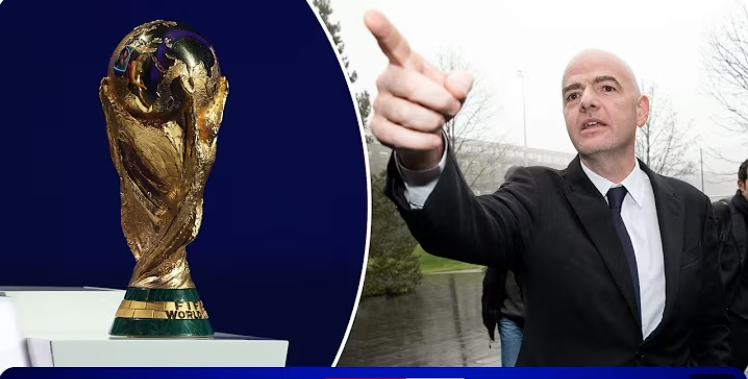
Gianni Infantino’s bold bid to open the World Cup’s commercial engine to private investors has plunged world football into its most serious governance crisis in years.
Just days after the 2026 tournament concluded, FIFA announced plans to create a new $20 billion subsidiary — FIFA Forward Enterprise (FFE) — that would control the commercial rights and operational delivery of its flagship competitions, including the men’s and women’s World Cups and the Club World Cup. The governing body intends to sell minority, non-controlling stakes (around 20%) to private investors, raising up to $4.2 billion.
FIFA would retain majority ownership and insists it will keep exclusive control over sporting decisions, competition formats, calendars and governance. The money raised, FIFA says, would massively boost development funding for its 211 member associations — more than $10 billion over the next four years — including one-off payments of around $20 million per federation (with further incentives for early support).
The lead investor is expected to be Thrive Eternal, the vehicle founded by Joshua Kushner (brother of Jared Kushner, son-in-law of U.S. President Donald Trump). JPMorgan is advising on the deal.
Europe’s fierce rejection
UEFA reacted with immediate and unusually strong condemnation. In a statement, European football’s governing body declared:
“This crosses a line that football’s governing institutions should never cross… The soul and governance of football are not assets to trade — especially with zero transparency as to who gains financially. None of us are the owners of football. It is not FIFA’s to sell.”
European associations are holding emergency talks this week. Senior figures have discussed the nuclear option of threatening a boycott of future World Cups or other FIFA competitions if the plan advances. United Kingdom Prime Minister Andy Burnham joined the criticism, stating that football “belongs to the people who fill the stands” and that the World Cup “was never anyone’s to sell.”
Why Infantino is pushing it — and why Europe fears it
Infantino frames the move as the “democratisation of football,” arguing that private capital will unlock far greater resources for poorer federations while professionalising the commercial side of the game. Supporters outside Europe point out that major leagues in Spain, France and elsewhere have already sold stakes in their commercial arms to private equity without losing sporting control.
Critics, however, see a dangerous precedent. They worry that once investors hold a stake in the World Cup’s commercial vehicle, pressure will grow to expand the tournament further, stage it more frequently, or prioritise revenue over sporting integrity and player welfare. The involvement of a firm linked to the Trump orbit has also raised political eyebrows, especially after Infantino’s close public relationship with the U.S. president during the 2026 finals.
This is not Infantino’s first attempt to bring in private money. A similar SoftBank-backed plan for an expanded Club World Cup collapsed in 2018 under European opposition. This time, FIFA appears better prepared, using financial incentives to secure the votes of the majority of its 211 members — most of whom sit outside Europe.
What happens next
Infantino has set a September 19 deadline for member associations to accept the initial funding offer tied to the plan. UEFA is coordinating a united European response, while other confederations have so far remained largely silent or unaware until the public announcement.
The saga is still unfolding, but the battle lines are clear: FIFA and its allies see a commercial revolution that spreads wealth globally; Europe sees the partial privatisation of the World Cup itself — and is prepared to fight hard to stop it.
Whether the plan survives will depend on whether the financial lure proves stronger than the principle that the World Cup should remain under the exclusive control of the game’s traditional custodians.


Leave a Reply